
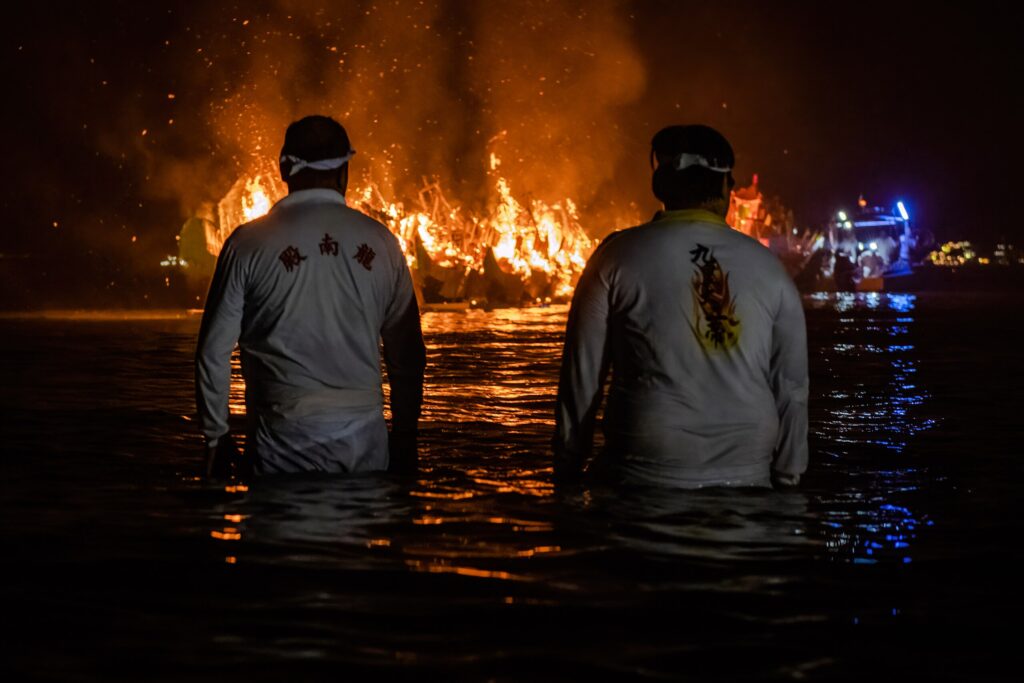
Parades featuring regal yellow floats, entranced revellers sporting piercings and even blades or boats being sent off into the dark sea.
Yes, it’s the Nine Emperor Gods Festival.
But what is this festival and why is it celebrated? Let’s take a look.
Origins and Practices
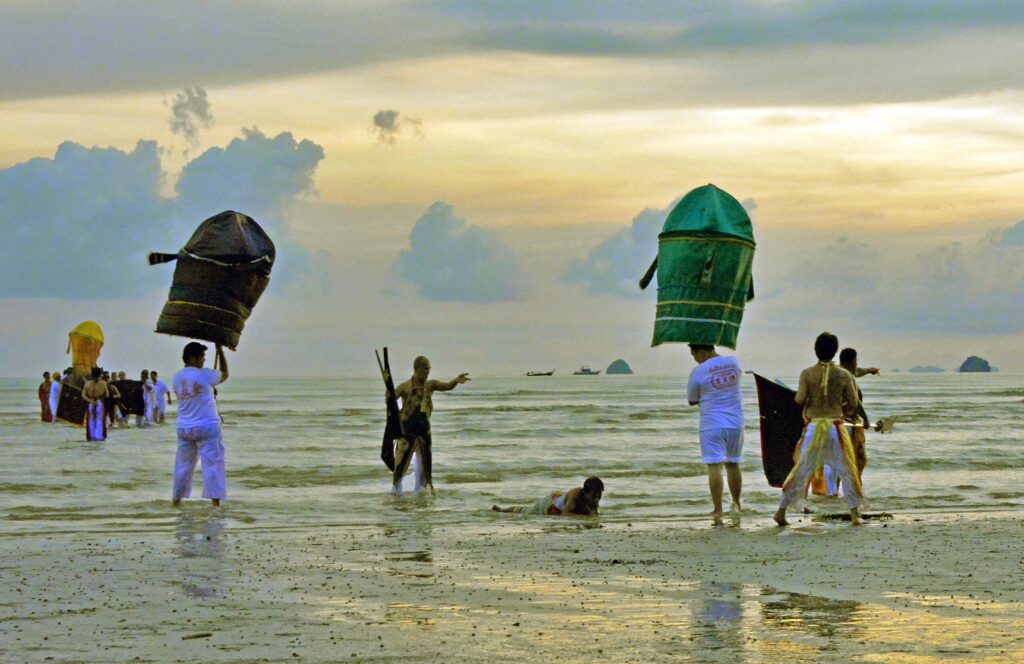
Celebrated over nine days from the eve of the ninth lunar month (Oct 20 as of 2025), the Nine Emperor Gods Festival is dedicated to these nine deities.
There’s just one catch – the identity of these nine deities!
Various stories and theories have been put forth on their identities, ranging from nine Ming loyalists rebelling against the Qing, actual celestial deities, or even rogue pirates with hearts of gold.
No matter which version you believe though, the festival usually centers upon an incense-filled censer that represents these nine deities. This is because in the above stories, the mortal heroes’ remains are usually lost or the deities are considered too sacred to behold directly.
Flocking to temples adorned in gold, devotees dressed in white – the traditional colour of mourning in Chinese cultures – pray, make offerings or participate in ritual mutilations and firewalking.
Water also plays a huge part in the festival, with paper boats being burned at rivers, lakes or the sea as a way to send off the gods.
What’s most surprising though, is despite its origins in southern Chinese and Taoist folk traditions, the festival is now mainly celebrated in Southeast Asia!
Phuket
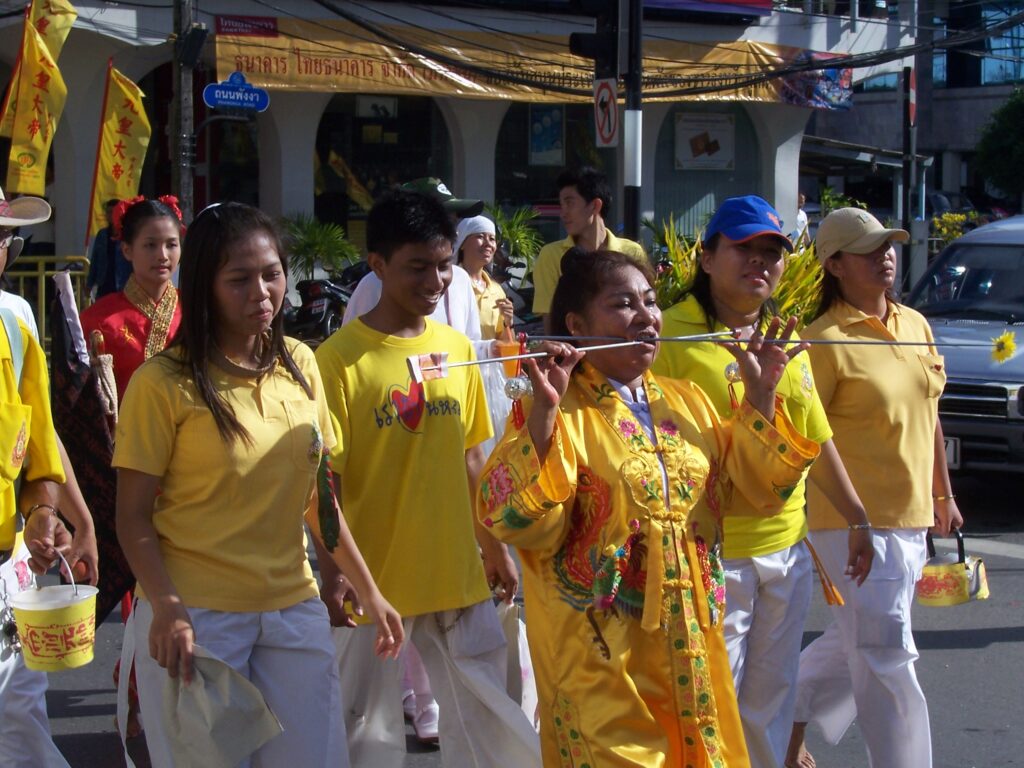
Known locally as the Vegetarian Festival, Phuket’s version of the Nine Emperor Gods Festival is one the earliest known on record, dating all the way to the early 1800s.
It was then that visiting Chinese opera performers advised local Fujianese labourers to observe a vegetarian diet to ward off a plague.
Since then, the festival has continued unabated for centuries at the tourist town’s many Chinese temples and shrines, particularly at the centuries-old Kathu Shrine where it all started.
As is expected in the culinary wonderland of Thailand, the festival features tons of food stalls offer a dizzying array of vegetarian foods from soybean pancakes to mushroom skewers and every vegetarian meat imaginable.
But the most famous aspects of Phuket’s festival are the Ma Song, ardent worshippers who act as spirit mediums through the use of ritual mutilations and piercings.
Penang
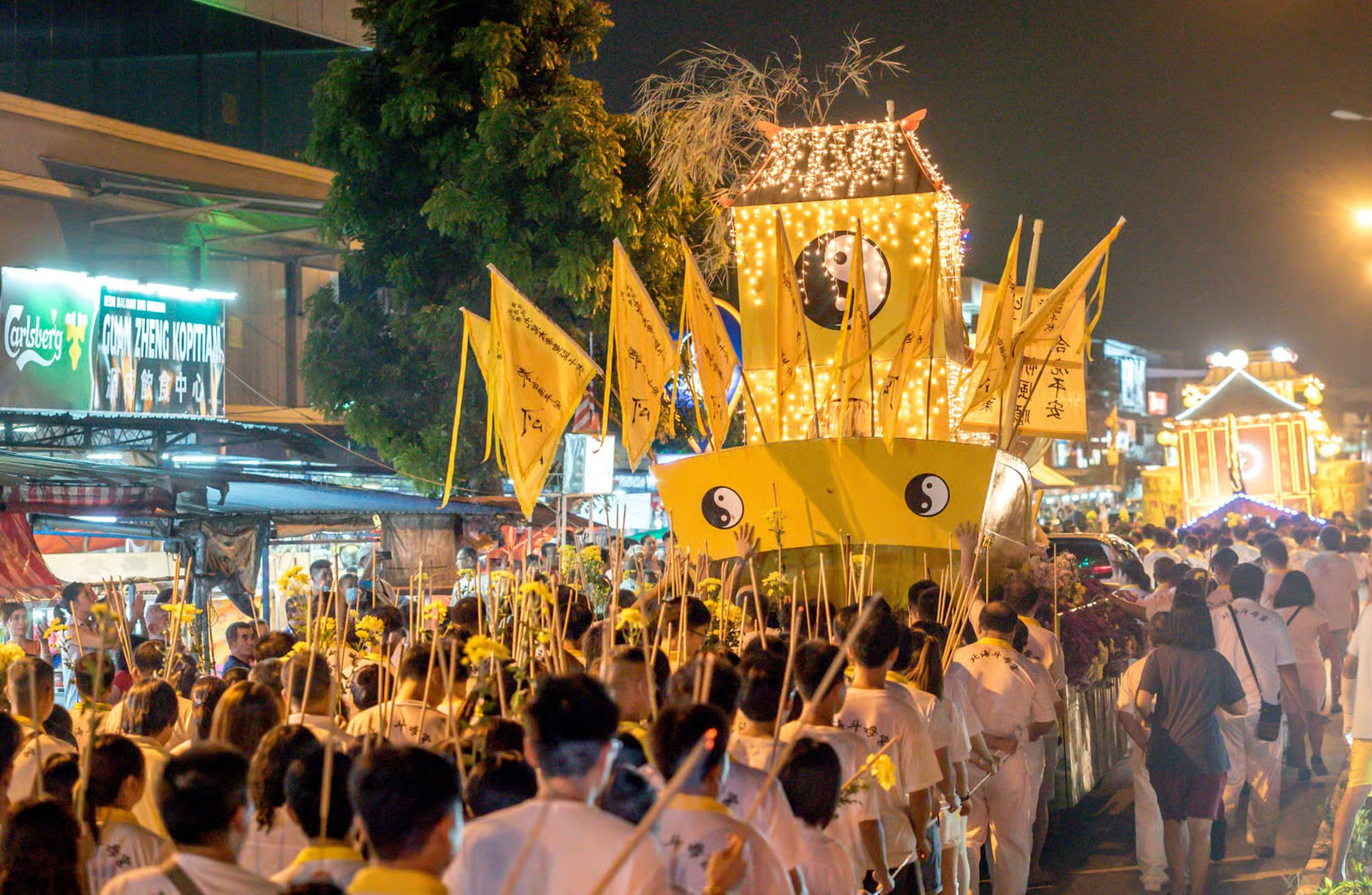
Vying with Phuket as one of the oldest iterations of the Nine Emperor Gods Festival, the Penang version is much flashier.
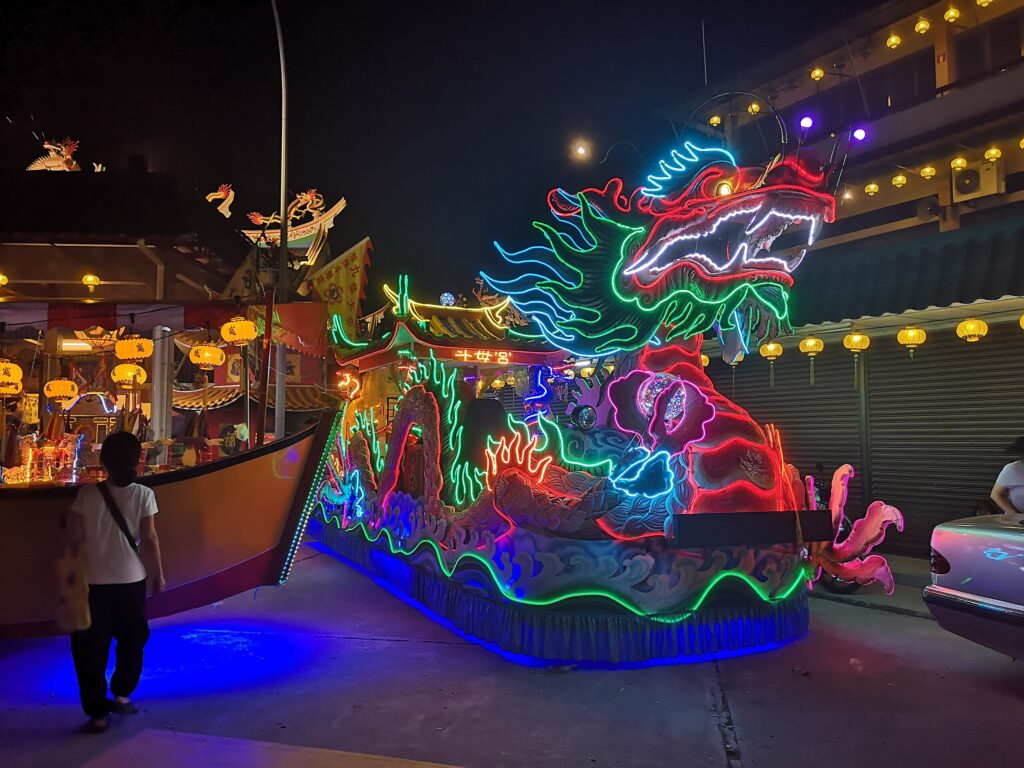
Here, massive LED-lit floats grace processions towards the rivers or seas – the traditional entry points of the deities – in order to welcome them.
Atop the main float, a sacred censer concealed underneath a golden cloth symbolizes the deities. Once they arrive at the shrine, they are usually kept concealed inside a room dubbed the Inner Palace.
Flocking these temples will be hundreds of devotees dressed in white and gold. Adhering to the idea that purity is achieved through strict vegetarianism, only those who have abstained from animal products for a day are even allowed to enter parts of the temple.
On Penang Island, the festival is usually held at the Tow Boo Kong Temples (Burma Road) and Tow Boe Keong Kew Ong Tai Tay Temple (Gat Lebuh Macallum). Meanwhile, Butterworth also has a festival at the Tow Boo Kong Temple at Jalan Raja Uda.
Kuala Lumpur
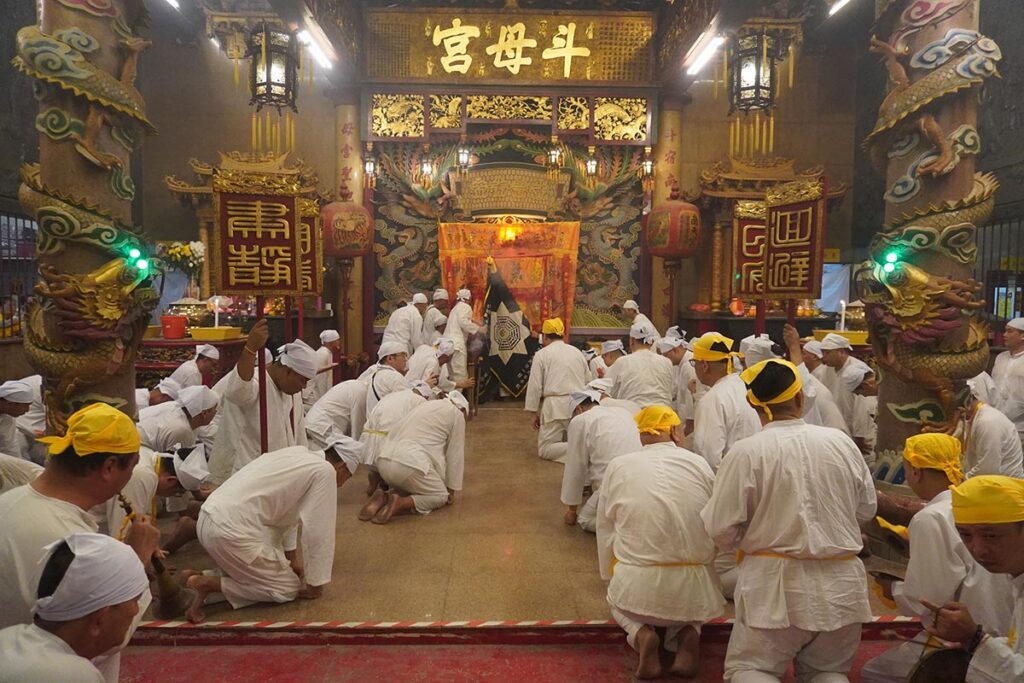
Down in the Malaysian capital, the favoured abode of the nine deities would have to be the aptly named Nine Emperor Gods Temple (Nantiangong) in Ampang.
Dominated by two pagodas that look fetching in their own right, the main courtyard transforms into a colourful vegetarian bazaar or festive firewalking mound depending on the day of the festival.
And as usual, the gods’ main palanquin features prominently during festivities, with the bearers swaying and shaking to the beat of drums and cymbals to symbolize the presence of the divine.
In the main hall, past the smoke wafting from countless incense sticks is the inner sanctum, where devotees submit an array of offerings before the deities.
Speaking of incense, ashes left over from burned incense sticks were carried all the way from Phuket to Ampang and enshrined within the temple. In time, these ashes would go on to sprout further temples in Melaka, Johor and eventually, Singapore – truly showcasing the resilience and adaptability of this Chinese festival.
Singapore
Established with incense ash brought over from Penang’s Dou Mu Gong Temple, the Hougang Tou Mu Kung Temple in Singapore is a modestly sized rectangular hall that wouldn’t look out of place in a provincial Chinese village.
But, what it lacks in grandeur it more than makes up for with community spirit, particularly during the welcoming and farewell ceremonies for the deities, where nine whole ship palanquins are lit up to symbolize the gods’ presence.
There’s also a festive conundrum unique to highly urbanized Singapore – bamboo.
Symbolizing virtue and honour in Taoism, bamboo stems are used in the Nine Emperor Gods Festival to mark the beginning and end of various ceremonies through the raising and lowering of kerosene lamps.
But since bamboo takes a whole decade to mature to the right size, Singaporean worshippers must carefully select and preserve what little bamboo supply they have in a closely guarded location.
At the end of the festival, to ward off ill fortune, a paper ship pasted with the names of loved ones is burned at sea.
More spiritual inspiration can be found in some of Malaysia’s most beautiful churches or awe-inspiring stargazing spots. Alternatively, explore more festival vibes with these lively spring festivals or moody winter festivals!
Links
International Institute for Asian Studies – The Nine Emperor Gods Festival in Southeast Asia: History, Networks, and Identity
https://www.iias.asia/the-newsletter/article/nine-emperor-gods-festival-southeast-asia-history-networks-and-identity
Roots.sg – The Nine Emperor Gods Festival
https://www.roots.gov.sg/ich-landing/ich/the-nine-emperor-gods-festival
The Straits Times – The Nine Emperor Gods Festival: Celebrating a celestial visit
https://www.straitstimes.com/multimedia/graphics/2024/10/nine-emperor-gods-festival-singapore/index.html
National Library Board – Nine Emperor Gods Festival
https://www.nlb.gov.sg/main/article-detail?cmsuuid=4f7db20e-7313-4be0-a67e-3aaf275efb8f
Malaymail – Two nine-day festivals coincide this year: Here’s what to know about the Nine Emperor Gods and Navaratri being celebrated now until Oct 11 (VIDEO)
https://www.malaymail.com/news/malaysia/2024/10/03/two-nine-day-festivals-coincide-this-year-heres-what-to-know-about-the-nine-emperor-gods-and-navaratri-being-celebrated-now-until-oct-11-video/152458
Penang.gov – Nine Emperor Gods Festival
https://www.mypenang.gov.my/all/my-stories/41/?lg=en


